
Best Sensory Toys for Every Age Group From Birth Onwards
A good sensory toy does more than keep little hands busy. It gives a child something safe and interesting to look at, hold, squeeze, mouth, listen to, chase, sort, stack, or calm down with.
From the first weeks of life through the school years, children use their senses to understand the world. The right toys can support that natural curiosity without overloading them. The key is choosing toys that match the child’s stage, not just their age.
This guide walks through the best sensory toys for each age group from birth onwards, using the kinds of products commonly found in a well-stocked sensory toy range, from soft rattles and textured teethers to fidget toys, sensory balls, liquid timers, and calming weighted items.

What makes a sensory toy a good choice
The best sensory toys are simple, safe, and purposeful. They invite a child to explore one or more senses without doing everything at once.
A strong sensory toy may support:
Touch
Textures, bumps, ridges, soft fabrics, squishy materials, and different shapes.
Sight
High contrast patterns, bright colours, moving glitter, mirrors, or visual tracking.
Sound
Gentle rattles, crinkles, bells, rainmakers, or cause-and-effect noise.
Movement
Rolling, crawling, reaching, balancing, squeezing, throwing, catching, and pushing.
Calm
Repetitive movement, pressure, slow visual effects, or quiet fidgeting.
Safety matters at every stage. Always check age guidance, inspect toys often, and avoid small parts for babies and toddlers. For children who mouth toys, choose items designed for chewing or teething rather than general fidgets.
From birth to 3 months
Newborn sensory play should be gentle. At this age, babies are still adjusting to light, sound, touch, and movement. They do not need noisy toys or busy activity centres. Simple, soothing items work best.
Good choices include:
High contrast sensory cards
Soft rattles
Crinkle cloths
Baby-safe mirrors
Soft fabric books
Tummy time mats
High contrast cards are especially useful in the early weeks because newborns respond well to bold black and white patterns. Place them where the baby can see them during awake time, but keep sessions short.
A soft rattle is another lovely first sensory toy. Look for one that is lightweight, easy for an adult to hold near the baby, and gentle in sound. Babies are not ready to shake it properly yet, but they can begin to turn towards sound and follow movement.
A crinkle cloth or soft fabric book adds texture and sound without needing batteries or bright lights. These toys are easy to use during tummy time, nappy changes, or quiet floor play.
Best pick for this stage: a high contrast sensory card set paired with a soft crinkle cloth.

From 3 to 6 months
Between 3 and 6 months, babies become more active with their hands. They start reaching, grasping, bringing toys to their mouth, and exploring texture more intentionally.
This is the time to introduce:
Textured teethers
Textured balls
Soft sensory cubes
Wrist and foot rattles
Play gym toys
Baby-safe mirrors
Textured teethers are a practical sensory choice because they combine touch, oral exploration, and comfort. Choose teethers with easy-grip shapes, raised textures, and baby-safe materials.
Soft sensory cubes can offer several experiences in one toy, such as crinkle panels, tags, mirrors, soft bumps, and gentle rattles. They are ideal for babies who are starting to roll, reach, and swipe.
Wrist and foot rattles can also be helpful because they connect movement with sound. A baby kicks or waves and hears a gentle noise, which supports cause-and-effect learning.
Keep toys close enough for the baby to reach, but not so close that they become overwhelmed. One or two toys at a time is plenty.
From 6 to 12 months
This is a big stage for sensory play. Babies may sit, roll, crawl, pull to stand, clap, bang, drop, and chase objects. They love toys that respond when they touch them.
Great options include:
Sensory balls
Stacking cups
Pop-up toys
Textured blocks
Musical shakers
Activity balls
Bath sensory toys
Sensory balls are one of the most useful toys for this age. Choose a set with different textures, sizes, and firmness levels. Babies can roll them, squeeze them, mouth them if they are designed for that use, and chase them across the floor.
Stacking cups are simple but brilliant. They support hand-eye coordination, size awareness, banging, hiding, pouring, and water play. Babies also enjoy knocking them down, which is part of the learning.
Textured blocks offer grip practice and early problem-solving. Softer blocks are useful for younger babies, while firmer ones suit those who are sitting steadily and starting to stack.
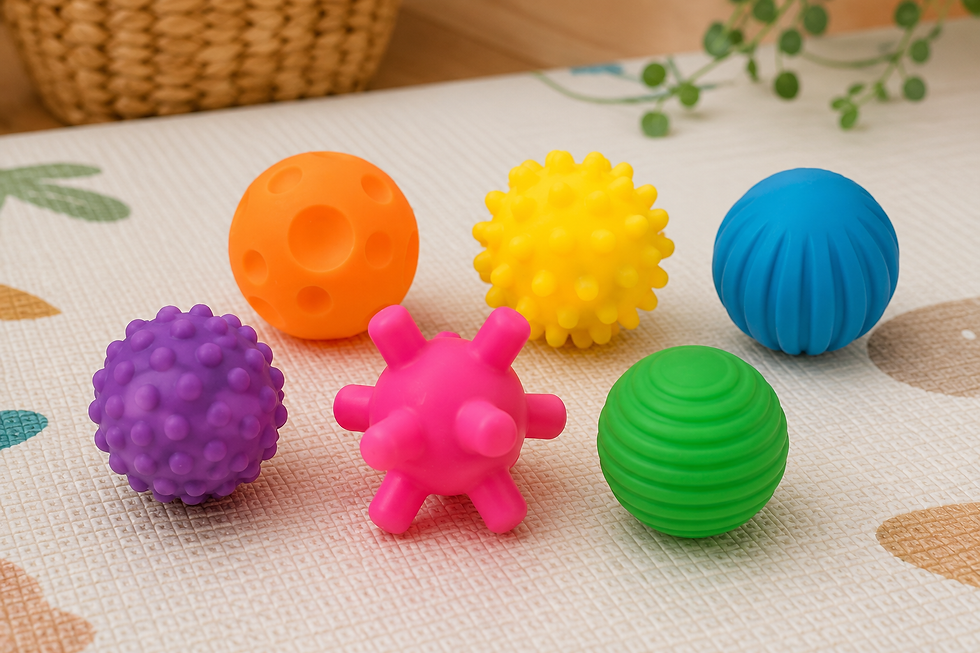
Best pick for this stage: a textured sensory ball set, because it grows with the child and supports several types of play.
From 12 to 18 months
Toddlers at this age are busy explorers. They want to post, push, pull, carry, tip, stack, and repeat the same action again and again. Repetition is not boring for them. It is how they learn.
Look for toys such as:
Shape sorters
Posting toys
Push-and-pop toys
Sensory bottles
Chunky puzzles
Spinning toys
Simple musical instruments
Shape sorters are a classic for good reason. They combine visual matching, hand control, problem-solving, and persistence. Start with simple shapes before moving to more complex sorters.
Push-and-pop toys can be satisfying for toddlers who enjoy cause and effect. They press, hear or feel the pop, and repeat. These toys can also help with finger strength.
Sensory bottles are calming and fascinating. Bottles with glitter, beads, or slow-moving liquid give toddlers something to watch closely. Use sealed, safety-tested sensory bottles from a trusted range rather than homemade bottles that may leak or break.
Simple instruments, such as egg shakers or mini rainmakers, support rhythm, listening, and movement. Keep sound levels gentle, especially for children who are sensitive to noise.
From 18 months to 2 years
At this stage, toddlers often want more active sensory input. They climb, squeeze, carry, jump, throw soft objects, and test how things work. They also begin to enjoy pretend play.
Useful sensory toys include:
Pop tubes
Soft play blocks
Fidget poppers
Play scarves
Large threading beads
Chunky peg boards
Sand and water tools
Pop tubes are popular because they stretch, bend, click, and compress. They give clear tactile and sound feedback. They are also good for bilateral coordination because children use both hands together.
Fidget poppers can be helpful for children who enjoy pressing, poking, and repeating patterns. Choose larger toddler-safe versions without small removable parts.
Play scarves are simple but versatile. Toddlers can wave them, hide objects under them, use them for peekaboo, toss them, or include them in pretend play. They offer visual movement without loud sound.
Large threading beads are suitable when the child is ready and the product is age-appropriate. They support fine motor skills, concentration, and colour sorting.
Best pick for this stage: pop tubes or large fidget poppers for hands-on, repeatable sensory input.
From 2 to 3 years
Two-year-olds often enjoy bigger sensory experiences. They are developing language, imagination, coordination, and independence. They may also have strong feelings and need help calming their bodies.
Good choices include:
Mini trampolines designed for young children
Balance stepping stones
Calming sensory bottles
Matching and sorting sets
Mini trampolines are excellent for developing coordination and providing a fun way to expend energy. They encourage physical activity in a safe environment.
Balance stepping stones help improve stability and balance skills while encouraging active play. Children can use them to create different paths and challenges.
Sensory bottles offer a mesmerising visual experience, promoting relaxation and focus as children watch the colourful liquid flow.
Calming sensory jars can be used to help children self-regulate and provide a soothing effect during moments of stress or overstimulation.
Matching and sorting sets enhance cognitive skills and fine motor development, allowing children to engage in playful learning activities.
Sensory bottles are a strong calming tool. The slow movement of bubbles, droplets, or coloured liquid gives children something steady to watch. They can be useful before nap time, after a busy outing, or during quiet play.
Balance stepping stones support movement, body awareness, and coordination. They suit children who seek active sensory input and enjoy physical challenges.

Best pick for this stage: balance stepping stones for activity and sensory bottles for calm-down moments.
From 3 to 5 years
Preschool children are ready for more complex sensory play. They can follow simple rules, build imaginative worlds, compare textures, and use sensory toys as part of social play.
Strong options include:
Sensory bins
Fidget toys
Visual timers
Balance boards
Light-up sensory toys
Fine motor tool sets
Play dough
Kinetic sand
Sensory bins can be themed around animals, vehicles, colours, seasons, or letters. Fill them with safe materials and add scoops, tongs, cups, and figures. This kind of play supports language, sorting, pretend play, and hand strength.
Visual timers help children understand time in a concrete way. They are useful for transitions, tidy-up time, turn-taking, and quiet play.
From 5 to 7 years
School-age children often need sensory toys for focus, calm, movement breaks, and emotional regulation. The best choices at this age are toys that feel grown-up enough while still being safe and useful.
Recommended products include:
Putty
Fidget cubes
Marble mazes
Chewable pencil toppers
Resistance bands for chairs
Wobble cushions
Liquid motion timers
Stress balls
Therapy putty or sensory putty works well for children who seek hand input. They can stretch, pinch, roll, twist, and hide small objects inside it if the set is designed for that use.
Fidget cubes and marble mazes are quieter than many other fidgets. They suit children who need something small to hold while listening or waiting.
Chewable pencil toppers can help children who chew sleeves, pencils, or fingers. They must be made for chewing and matched to the child’s chewing strength.
Wobble cushions and chair bands support movement while sitting. Some children focus better when their body can move a little. These products should not turn sitting into a balancing challenge. The aim is gentle input, not distraction.
Best pick for this stage: sensory putty or a quiet fidget cube for focus and hand input.
From 7 years and upwards
Older children still benefit from sensory support. Their needs may become more specific. Some want calm after school. Some need focus tools for homework. Others seek movement, pressure, or quiet visual input.
Useful choices include:
Advanced fidget sets
Magnetic fidget rings
Thinking putty
Weighted shoulder wraps
Visual calm-down bottles
Resistance putty
Puzzle balls
Desk-friendly fidgets
Noise-reducing ear defenders
At this age, children often have clear preferences. Some love putty. Others hate sticky textures. Some want smooth metal fidgets. Others prefer soft squishy toys. Letting them choose from a small selection can make the toy more useful.
Desk-friendly fidgets should be quiet, compact, and non-messy. Good options include marble mazes, smooth fidget sliders, small stress balls, or magnetic rings if they are age-appropriate.
Visual calm-down tools, such as liquid timers or sensory bottles, can help older children pause when they feel overloaded. They also work well in calm corners, reading spaces, or bedtime routines.
Weighted shoulder wraps or lap pads may suit some older children who enjoy deep pressure. Follow the product guidance carefully and use them only when the child wants that input.
How to match a sensory toy to a child
Age guidance is helpful, but it is not the only factor. Sensory preferences, motor skills, and safety all matter.
A child who seeks movement may prefer stepping stones, wobble cushions, or balance boards. A child who needs hand input may enjoy putty, poppers, textured balls, or stress toys. A child who becomes overloaded may prefer slow visual toys, soft textures, or calming pressure.
Use these quick checks before choosing:
Check the age rating
This is especially important for small parts, magnets, and chew items.
Think about the main sensory need
Is the child seeking touch, sound, movement, pressure, oral input, or visual calm?
Choose one main feature
A toy does not need lights, music, texture, and movement all at once.
Watch the child’s response
If a toy calms, focuses, or engages them, it is likely a good match. If it irritates or overstimulates them, put it away and try something simpler.
Rotate toys
A smaller choice of toys often works better than a crowded toy box.
A simple age-by-age sensory toy guide
Age group | Best sensory toy types | Why they work |
Birth to 3 months | High contrast cards, soft rattles, crinkle cloths | Gentle sight, sound, and touch |
3 to 6 months | Textured teethers, soft cubes, baby mirrors | Reaching, grasping, mouthing, tracking |
6 to 12 months | Sensory balls, stacking cups, textured blocks | Crawling, rolling, squeezing, cause and effect |
12 to 18 months | Shape sorters, posting toys, sensory bottles, rainmakers | Problem-solving, hand control, visual calm |
18 months to 2 years | Pop tubes, fidget poppers, sensory scarves, musical instruments | Repetition, movement, two-handed play |
2 to 3 years | textured stepping stones, sensory bottles, matching games | Tactile play, creativity, calming routines |
3 to 5 years | Sensory bins, magnetic tiles, weighted lap pads | Imagination, fine motor skills, regulation |
5 to 7 years | Putty, fidget cubes, wobble cushions | Focus, hand input, seated movement |
7 years and up | Desk fidgets, thinking putty, visual timers | Calm, concentration, independence |
Choosing sensory toys by age helps you start in the right place, but the child’s response is the real guide. Begin with safe, simple products. Notice what they reach for, repeat, avoid, or return to when they need calm.
From newborn contrast cards to school-age fidgets, the right sensory toy can support curiosity, comfort, movement, and focus at every stage.


Comments